Designing, building, and testing computer codes to simulate the physics of the coastal ocean
The Computational Hydraulics Laboratory (CHL) develops computer codes and modeling methodologies to simulate the hydrodynamics of the coastal ocean and the adjacent estuarine, riverine and floodplain systems. Our work is cross disciplinary and encompasses: the fundamental algorithmic developments to solve the underlying partial differential equations; the optimization of unstructured meshes to better match resolution needs locally; the development of high performance codes in vector and parallel computing environments; the linkages of coastal ocean circulation models to weather, non-phase and phase resolving wind wave, hydrology, and global ocean circulation models; model verification, validation, and uncertainty quantification; and the application of these codes to oceans, continental shelf regions, estuaries, rivers, and coastal floodplains. We are at the interface of the computations and physics of the oceans and coasts.
Our unstructured mesh, multi-scale, multi-physics hydrodynamic codes and models for the coastal ocean are transitioned to practitioners for a wide range of applications including the analysis and design of major flood control projects, coastal ocean water level forecasting systems, fish larval transport, pollutant transport, and sediment transport studies for dredging operations. Our work has especially led to better estimates of hurricane related risk associated with waves, storm surge, tides, and currents in the coastal zone. Target applications include risk and vulnerability assessments of coastal structures, ports, ships, moored barges, utility and energy distribution systems, offshore and onshore pipelines and energy production rigs.
We are the founding co-developers, with the University of North Carolina at Chapel Hill and the University of Texas at Austin, of the widely used ADCIRC finite element based shallow water equation code. ADCIRC has evolved into a community based coastal hydrodynamics code with wide ranging applications within academia, government, and the private sector worldwide. The U.S. Army Corps of Engineers, the Federal Emergency Management Agency and the National Oceanic and Atmospheric Administration all use ADCIRC in support of coastal water level and flooding analyses and forecasts. Notably ADCIRC was used to design the 15 billion dollar Hurricane & Storm Flood Risk Reduction System (HSDRRS) for New Orleans by the Army Corps of Engineers (USACE). ADCIRC has been used by the USACE for the North Atlantic Coast Comprehensive Study and is being used for the current study along the South Atlantic coast. The Federal Emergency Management Agency (FEMA) applies ADCIRC to evaluate hurricane flood risk along the U.S. East, Gulf and Great Lakes coasts in support of the National Flood Insurance Program. The Department of Homeland Security and U.S. Coast Guard use ADCIRC as a decision support tool to help them prepare for the impending hurricane landfall (1, 2). The National Oceanic and Atmospheric Administration (NOAA) uses ADCIRC in support of forecasting tides and extratropical storms (ESTOFS), tropical storms (HTOFS), and vertical datum transformation (VDATUM) tools. ADCIRC is also used for U.S. nuclear power station flood risk assessment required by the NRC. Industrial users include Michael Baker Corporation, ARCADIS, AECOM, URS, Dewberry, IBM, FMGlobal, and Taylor Engineering.
Our laboratory develops comprehensive multi-process, multi-scale, integrated domain, and high resolution unstructured mesh models and codes that include the broad energy spectrum of the ocean ranging from trans-tidal waves, ordinary tide waves, infra gravity waves to ordinary gravity waves. Processes include tides, wind and atmospheric pressure driven flow, wind waves, wind wave current interaction, rivers, rainfall, baroclinically driven circulation, and sediment erosion. Our models apply large domains that extend from the deep ocean, over the continental shelf, into coastal waters, and across the floodplain and into vulnerable coastal riverine systems to comprehensively capture the wide range of scales and processes that occur without needing nested solutions that require inaccurate and non-robust boundary coupling strategies. Our laboratory has pioneered the use of global to channel scale coastal ocean models with mesh resolution varying by up to four orders of magnitude. The models provide high mesh resolution locally to resolve the system's physical features and its hydrodynamic processes as needed.
Our current research includes: the development of high order h-p adaptive Discontinuous Galerkin based circulation codes designed to be orders of magnitude more efficient and flexible than current generation codes; incorporating phase resolving wave processes including run-up directly into circulation codes; understanding resonant basin and shelf modes and shelf dissipation processes; incorporating regional and local rainfall and small scale channel routing capabilities into shallow water based codes; dynamically switching between gravity driven hydrologic physics and wave propagation shallow water equation physics on the coastal floodplain; sea ice interaction with wind waves and circulation; downscaling global ocean models into global high resolution coastal models to account for baroclinicity and sea level fluctuations; integration of regional models into global meshes; and improved automated mesh generation and re-generation at runtime. Current applications regions include developing the next generation of ESTOFS water level forecast models for NOAA focusing on Puerto Rico and the U.S. Virgin Islands; the U.S. East and Gulf coasts, and Alaska.
Our laboratory is also focused on teaching and mentoring of both undergraduate and graduate students, with lab members having been awarded 19 outstanding teacher and teaching assistant awards. Former graduate students and postdoctoral associates are in academia, government, and industry and work in leading positions in coastal and hurricane related studies.
Joseph and Nona Ahearn Professor in Computational Science and Engineering
Department of Civil and Environmental Engineering and Earth Sciences
1984 Ph.D. Civil Engineering, Massachusetts Institute of Technology
1981 M.S. Civil Engineering, State University of New York at Buffalo
1979 B.S. Civil Engineering, Summa Cum Laude, State University of New York at Buffalo
Research Associate Professor
High performance DG finite element solutions to shallow water equations, transport equations and Navier Stokes equations.
2007 Ph.D. Aerospace and Mechanical Engineering, University of Notre Dame
2005 M.Sc. Mechanical Engineering, University of Notre Dame
1999 M.Eng. Mechanical Engineering, King Mongkut's Institute of Technology North Bangkok
1997 B.Eng. Mechanical Engineering, King Mongkut's Institute of Technology North Bangkok
Research Assistant Professor
Propagating uncertainty through hydrodynamic simulation frameworks with machine learning and ensemble forecasts
2014 Ph.D. Civil and Environmental Engineering, Cornell University
2009 B.S. Civil and Environmental Engineering, University of Notre Dame
Graduate Research Assistant
Investigating large-scale fluid flow hazards (tsunamis, dam failures, landslides, storms) by combining numerical modeling and remote-sensing methods
2021 B.S. Geosciences, Emphasis in Hydrology; Minor: Accessibility Studies, Boise State University
hspero@nd.edu
Graduate Research Assistant
Advancing global-scale coupled wind-wave, tide, and storm surge models to improve the accuracy of total water level predictions
2022 MTech, Water Resources Engineering & Management, IIT Kharagpur
2020 BTech, Agricultural Engineering, SHUATS Prayagraj
Graduate Research Assistant
Long-term sea level simulation / Wave-debris-structure interaction
2024 M.Eng. Civil Engineering, Kyoto University
2022 B.Eng. Civil Engineering, Kyoto University
Former Lab Members
Click to view our alumni who are now in academia, government, and industry
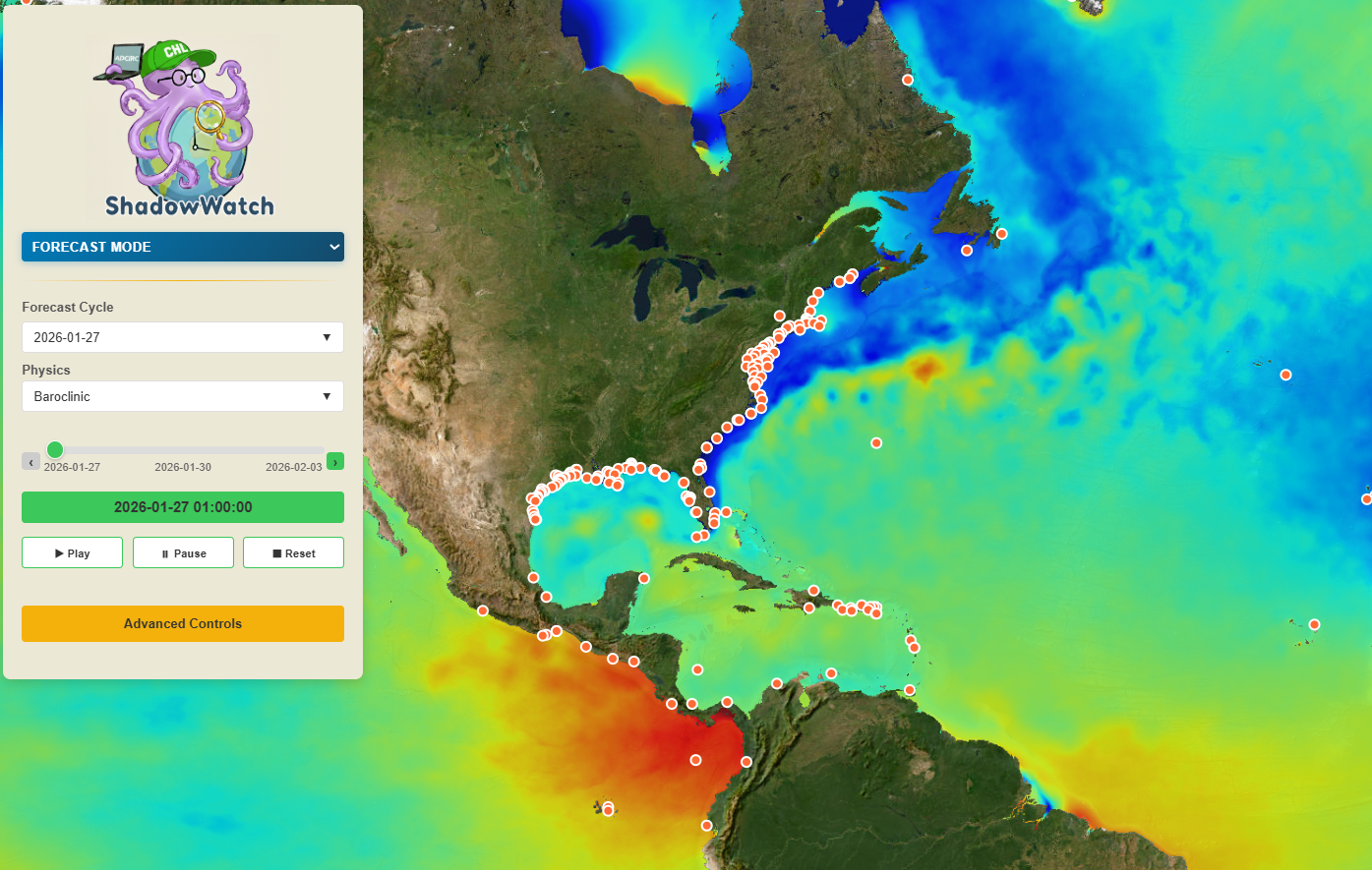
STOFS-2D-Global Shadow is a development instance of NOAA's ADCIRC-driven STOFS-2D-Global. It is operated by the Computational Hydraulics Laboratory at the University of Notre Dame.
The system has global coverage with sub-kilometer resolution in US coastal waters. It operates once-daily, rendering a 7-day forecast beginning midnight UTC. It is also validated daily against hundreds of NOAA CO-OPS and UNESCO stations.
Check out https://chl.crc.nd.edu/ for more!
Restoration Ecology, e14383, 2025
View Publication βOcean Modelling, 195, 2025
View Publication βJournal of Advances in Modeling Earth Systems, 16, 12, 2024
View Publication βWeather and Forecasting, 39 (5), 793-806, 2024
View Publication βWeather and Climate Extremes, 45, 100689, 2024
View Publication βGeoscientific Model Development, 16, 1297-1314, 2023
View Publication βCoastal Engineering, 2023
View Publication βJournal of Waterway, Port, Coastal, and Ocean Engineering, 149, 1, 2023
View Publication βOcean Modeling, 182, 102160, 2023
View Publication βEcosphere, 14:e4337, 2023
View Publication βJournal of Advances in Modeling Earth Systems, 14, 11, 2022
View Publication βJournal of Geophysical Research: Oceans, 127, 2022
View Publication βJournal of Marine Science and Engineering, 9, 12, 1322, 2021
View Publication βJournal of Geophysical Research: Oceans, 126, 7, e2021JC017319, 2021
View Publication βCoastal Engineering, 169, 2021
View Publication βEnvironmental Modelling & Software, 140, 2021
View Publication βGeoscientific Model Development, 14(2), 1125-1145, 2021
View Publication βJournal of Waterway, Port, Coastal, and Ocean Engineering, 146, 4, 2020
View Publication βOcean Modeling, 144, 101509, 2019
View Publication βComputer Methods in Applied Mechanics and Engineering, 335, 860-899, 2019
View Publication βOcean Modeling, 141, 101421, 2019
View Publication βJournal of Geophysical Research - Oceans, 124, 4, 2876-2907, 2019
View Publication βGeoscientific Model Development, 12, 1847-1868, 2019
View Publication βJournal of Geophysical Research - Oceans, 124, 2196-2217, 2019
View Publication βOcean Modeling, 129, 13-38, 2018
View Publication βInternational Journal for Numerical Methods in Fluids, 88, 141-168, 2018
View Publication βApplied Ocean Research, 67, 136-147, 2017
View Publication βJournal of Natural Hazards, 88, 3, 1423-1449, 2017
View Publication βMonthly Weather Review, 145(3), 929-954, 2017
No link availableJournal of Scientific Computing, 70, 210-242, 2017
View Publication βCoastal Engineering, 114, 61-76, 2016
No link availableOcean Engineering, 111, 290-309, 2016
No link availableJournal of Scientific Computing, 66, 1, 406-434, 2016
View Publication βJournal of Computational Physics, 299, 579-612, 2015
No link availableAdvances in Water Resources, 78, 60-79, 2015
No link availableOcean Modeling, 86, 36-57, 2015
No link availableJournal of Computational Physics, 273, 572-588, 2014
No link availableOcean Modeling, 79, 43-53, 2014
No link availableSIAM/ASA Journal of Uncertainty Quantification, 2, 174-202, 2014
No link availableCoastal Engineering, 84, 1-9, 2014
View Publication βComputer Methods in Applied Mechanics and Engineering, 270, 113-149, 2014
View Publication βOcean Dynamics, 63, 1341-1344, 2013
View Publication βJournal of Disaster Research, 8, 1042-1051, 2013
View Publication βProceedings of the National Academy of Sciences of the United States of America, 110, 29, E2665-E2666, 2013
View Publication βAdvances in Water Resources, 59, 95-110, 2013
No link availableJournal of Geophysical Research: Oceans, 118, 4633-4661, 2013
View Publication βJournal of Geophysical Research: Oceans, 118,10, 5129-5172, 2013
View Publication βJournal of Geophysical Research: Oceans, 118, 4424-4460, 2013
View Publication βJournal of Geophysical Research: Oceans, 118, 10, 5054-5073, 2013
View Publication βJournal of Geophysical Research: Oceans, 118, 3350-3369, 2013
View Publication βJournal of Applied Meteorology and Climatology, 52, 2139-2146, 2013
No link availableOcean Modeling, 70, 85-102, 2013
No link availableComputer Methods in Applied Mechanics and Engineering, 259, 154-165, 2013
No link availableCoastal Engineering, 73, 13-27, 2013
No link availableJournal of Hydraulic Engineering, 139, 492-501, 2013
No link availableNatural Hazards, 66, 1443-1459, 2013
No link availableJournal of Waterway, Port, Coastal, and Ocean Engineering, 139, 171-182, 2013
No link availableJournal of Waterway, Port, Coastal, and Ocean Engineering, 139, 326-335, 2013
No link availableOcean Modelling, 52-53, 54-68, 2012
No link availableContinental Shelf Research, 41, 17-47, 2012
No link availableJournal of Scientific Computing, 52, 468-497, 2012
No link availableAdvances in Water Resources, 34, 1666-1680, 2011
No link availableJournal of Computational Physics, 230, 22, 8028-8056, 2011
No link availableGeophysical Research Letters, 38, L08608, 2011
View Publication βAdvances in Water Resources, 34, 1165-1176, 2011
View Publication βJournal of Scientific Computing, 46, 329-358, 2011
No link availableMonthly Weather Review, 139, 2488-2522, 2011
View Publication βComputer Methods in Applied Mechanics and Engineering, 200, 189-207, 2011
No link availableCoastal Engineering, 58, 45-65, 2011
No link availableWeather and Forecasting, 25, No. 6, 1577-1602, 2010
No link availableInternational Journal for Numerical Methods in Fluids, 64, 1336-1362, 2010
No link availableOcean Engineering, 37, 91-103, 2010
No link availableMonthly Weather Review, 138, 378-404, 2010
No link availableMonthly Weather Review, 138, 345-377, 2010
No link availableJournal of Scientific Computing, 40, 315-339, 2009
No link availableComputer Methods in Applied Mechanics and Engineering, 198, 1766-1774, 2009
No link availableComputer Methods in Applied Mechanics and Engineering, 198, 1548-1562, 2009
No link availableAnnual Journal of Coastal Engineering, Japan Society of Civil Engineers, 55, 316-320, 2008
No link availableJournal of Computational Physics, 227, 9697-9710, 2008
No link availablePhysics Today, 61, 9, 33-38, 2008
No link availableMonthly Weather Review, 136, 3, 833-864, 2008
No link availableJournal of Computational Physics, 222, 832-848, 2007
No link availableJournal of Hydraulic Engineering, 133, 305-311, 2007
No link availableMarine Technology Society Journal, 40, 4, 56-68, 2006
No link availableComputer Methods in Applied Mechanics and Engineering, 196, 437-451, 2006
No link availableOcean Modeling, 15, 71-89, 2006
No link availableInternational Journal for Numerical Methods in Fluids, 52, 63-88, 2006
No link availableInternational Journal for Numerical Methods in Fluids, 51, 1277-1296, 2006
No link availableInternational Journal for Numerical Methods in Fluids, 47, 1451-1468, 2005
No link availableInternational Journal for Numerical Methods in Fluids, 45, 715-749, 2004
No link availableInternational Journal for Numerical Methods in Fluids, 45, 689-714, 2004
No link availableInternational Journal for Numerical Methods in Fluids, 35, 669-686, 2001
No link availableInternational Journal for Numerical Methods in Fluids, 32, 241-261, 2000
No link availableInternational Journal for Numerical Methods in Fluids, 26, 369-401, 1998
No link availableInternational Journal for Numerical Methods in Fluids, 22, 603-618, 1996
No link availableJournal of Geophysical Research, 100, C7, 13719-13735, 1995
No link availableJournal of Geophysical Research, 99, C9, 18467-18479, 1994
No link availableInternational Journal for Numerical Methods in Fluids, 19, 295-319, 1994
No link availableInternational Journal for Numerical Methods in Fluids, 18, 1021-1060, 1994
No link availableTellus, 46A, 178-199, 1994
No link availableJournal of Hydraulic Research, 32, 1, 3-24, 1994
No link availableComputers and Fluids, 23, 3, 523-538, 1994
No link availableNumerical Methods for Partial Differential Equations, 10, 491-524, 1994
No link availableJournal of Hydraulic Engineering, 118, 1373-1390, 1992
No link availableReviews of Geophysics, 29, April Supplement, 210-217, 1991
No link availableInternational Journal for Numerical Methods in Fluids, 12, 911-928, 1991
No link availableInternational Journal for Numerical Methods in Engineering, 30, 397-418, 1990
No link availableAdvances in Water Resources, 12, 166-183, 1989
No link availableJournal of Physical Oceanography, 19, 1350-1373, 1989
No link availableInternational Journal for Numerical Methods in Engineering, 28, 1077-1101, 1989
No link availableInternational Journal for Numerical Methods in Fluids, 8, 813-843, 1988
No link availableAdvances in Water Resources, 10, 188-199, 1987
No link availableComputational Hydraulics Laboratory
Department of Civil and Environmental Engineering and Earth Sciences
University of Notre Dame
156 Fitzpatrick Hall
Notre Dame, IN 46556
Diane Westerink
Coordinator, Computational Hydraulics Laboratory
303a Cushing Hall
Notre Dame, IN 46556-0767
westerink.5@nd.edu
574-631-4005
Joannes J. Westerink
Joseph and Nona Ahearn Professor in Computational Science and Engineering
Department of Civil and Environmental Engineering and Earth Science
University of Notre Dame
303a Cushing Hall
Notre Dame, IN 46556-0767
jjw@nd.edu
Phone: 574-631-6475
Cell: 574-532-3160
Fax: 574-631-9236